Fire, smoke, water and mold: damaged media
First response for media that has been through a wildfire, flood or years in a damp basement: what to do in the first 48 hours, what never to do, and what is for specialists.
🧰 What you'll need
Every tool and supply named in this unit. Dotted-underlined words in the text jump back here. Buttons open that store's search for the exact product. Prices are rough ranges in Canadian dollars.
Nitrile gloves, powder-free under $25
What it is: Thin disposable rubber-like gloves. They keep skin oil off film and glossy photos and still let you grip.
Our pick: Any powder-free nitrile exam gloves, in your size (S, M, L). Not latex, not vinyl.
In a store: Pharmacy, Costco, hardware store
Rocket blower under $25
What it is: A rubber bulb you squeeze. It puffs clean dry air to push dust off without touching.
Our pick: Giottos Rocket Air Blaster, large
In a store: Camera store
Anti-static brush $25 to $100
What it is: A very soft brush whose fibres remove static, so dust lets go of film and prints.
Our pick: Kinetronics StaticWisk, 2 inch or 4 inch
In a store: Camera store
Microfiber cloths under $25
What it is: Soft woven cloths that lift dust and smears without scratching glass.
Our pick: MagicFiber microfiber cleaning cloths, pack of 6 or more. Wash with no fabric softener.
In a store: Dollar store, optical shop, hardware store
N95 mask under $25
What it is: A fitted filter mask that stops mold spores and soot. A cloth or surgical mask does not.
Our pick: 3M 8210 N95 respirator
In a store: Hardware store, safety supply
Polyester (Mylar) sleeves $25 to $100
What it is: A crystal-clear, chemically safe plastic pocket, open on two sides. A tacky or flaking photo goes inside so it can be scanned and stored without touching anything.
Our pick: Archival polyester L-sleeves (sold as Mylar or Melinex), 5x7 and 8.5x11 inch
In a store: Carr McLean
Blotter paper $25 to $100
What it is: Thick, soft, absorbent, acid-free paper. Wet or humidified photos dry between or on top of it.
Our pick: Archival blotting paper sheets
In a store: Carr McLean, art store (watercolour blotter)
PEC-12 film cleaner $25 to $100
What it is: A solvent made for cleaning film and slides. Removes fingerprints, grease and mold residue. Supervisor only, ventilated.
Our pick: PEC-12 Photographic Emulsion Cleaner, 4 oz
In a store: Camera store
Hair dryer with a low setting $25 to $100
What it is: An ordinary hair dryer. Only its LOW heat setting is used, briefly, from behind an album page.
Our pick: Any hair dryer with a low or cool setting
In a store: Pharmacy
Safety glasses under $25
What it is: Clear impact-rated glasses for work with broken glass, soot and mold.
Our pick: Any CSA-rated safety glasses
In a store: Hardware store
Rewinds and film viewer $25 to $100
What it is: Two hand cranks with a small lit screen between them. You wind film slowly from one reel to the other and see each frame.
Our pick: A used "dual 8 editor viewer" for Regular 8 and Super 8 (Goko, Minette, Baia)
In a store: Second-hand only
Film cleaner $25 to $100
What it is: A liquid that dissolves grime on movie film and lubricates it. Applied with a lint-free cloth.
Our pick: FilmGuard, or Edwal Anti-Stat Film Cleaner
In a store: Specialist film suppliers
S-VHS VCR $100 to $500
What it is: A video cassette player. S-VHS models with a built-in TBC give the cleanest picture. We also keep a cheap one for risky tapes and one only for cleaning.
Our pick: Used JVC HR-S7000 to HR-S9000 series, or Panasonic AG-1980. A second, ordinary VHS VCR for rough use.
In a store: Second-hand: eBay, Marketplace, thrift stores
Donor shells under $25
What it is: An empty cassette shell taken from a tape nobody needs. A client's tape reels are moved into it when their own shell is broken.
Our pick: Screwed-together VHS tapes and 5-screw audio cassettes
In a store: Thrift stores
Distilled water under $25
What it is: Water with the minerals removed, so it leaves no deposit when it dries.
Our pick: 4 L jug of distilled water (not spring water)
In a store: Grocery store, pharmacy
Soot sponge under $25
What it is: A dry rubber sponge that lifts soot when pressed and lifted. Used dry. Never wetted.
Our pick: Absorene dry cleaning soot sponge
In a store: Hardware store, restoration supply
Silica gel under $25
What it is: Packets of beads that absorb moisture from the air in a sealed box or bag.
Our pick: Rechargeable silica gel packs with colour indicator
In a store: Amazon, camera store
Drying screens under $25
What it is: Clean fibreglass window screens laid flat on blocks, so air reaches both sides of wet photos.
Our pick: Fibreglass window screen in a frame, or a roll of screen mesh over a wooden frame
In a store: Hardware store
HEPA vacuum $100 to $500
What it is: A vacuum with a filter fine enough to trap mold spores and not blow them back out.
Our pick: Any canister vacuum with a sealed, true HEPA filter
In a store: Hardware store
Dehumidifier $100 to $500
What it is: A machine that pulls water out of the air so wet items dry faster and mold slows.
Our pick: Any 20 to 35 pint room dehumidifier
In a store: Canadian Tire, hardware store
Safety before media
- 1Photograph everything as it arrives, before touching
- 2Keep it in the bags or boxes it came in until you are in the cleaning area
- 3Nothing from a damaged job goes near the scan station, decks or other clients' media until it is clean and dry
The 48 hour rule for wet items
Mold starts growing on wet paper, photos and tape in about 48 hours. Wet items are dried or frozen before then.
| Item, wet | Do | Never |
|---|---|---|
| Photo prints | Rinse off mud in clean cool water. Lay face up on blotter, screen or paper towel to air dry. Or freeze if there are too many to dry within 48 hours. | Stack, wipe the surface, use heat or sunlight |
| Photos stuck together or in a wet album | Keep them wet in clean cool water, or freeze, until a supervisor can work on them (Unit 7) | Let them dry stuck together |
| Negatives and slides | Rinse in clean cool water, final rinse distilled, hang to dry by a corner clip or lay emulsion up | Touch the emulsion while wet. It is as soft as jelly. |
| Framed photos | Open the frame while still wet and lift the photo off the glass before it dries stuck | Let it dry in the frame |
| Paper documents | Air dry flat on blotter, or interleave with paper towel and change often. Freeze large amounts. | Unfold wet brittle paper. Use a hair dryer on hot. |
| Videotape and audio tape | Keep tapes that are wet wet (in clean cool water, sealed bag) until a supervisor can rinse with distilled water and air dry them in the open shell | Play them. Freeze them. Dry with heat. |
| Movie film | Keep wet and get to a film lab for rewashing, or rinse in clean water and air dry unspooled, supervisor only | Let a wet reel dry in a roll: it becomes a solid block |
| Discs (CD, DVD) | Rinse with distilled water, dry centre to edge, stand upright | Wipe in circles. Leave in a wet paper sleeve. |
| Records | Rinse vinyl, dry with microfiber. Remove from wet jackets. Dry jackets separately. | Wet-clean shellac with alcohol. Leave in a wet sleeve: mold grows on the label. |
Air drying photos
- 1Clean table, clean window screens or blotter paper, a fan moving air across the room (not pointed at the photos)
- 2Rinse each photo by holding its edges and moving it gently through cool clean water
- 3Lay face up, not touching
- 4Turn on a dehumidifier if we have one
- 5When fully dry, prints will curl. Flatten under blotter and weight (Unit 7).
- 6Scan as soon as they are dry and flat
Smoke and soot
- Soot is oily, acidic and abrasive. Rubbing it grinds it into the surface.
- Smell is not damage, but soot left on photos and film keeps eating them.
- 1Outside or in the cleaning area, mask on
- 2Loose soot: blower, then a soft brush used with a lifting flick, away from the item
- 3Paper, album covers, tape shells, record jackets: dry soot sponge
A vulcanized rubber "chemical sponge". Press and lift in straight strokes. Never scrub. Slice off the dirty surface of the sponge as it blackens.
- 4Photo surfaces: blower and brush only. No sponge on the image. Capture, then fix digitally.
- 5Tape cassettes
Clean the outside. Open the shell: if soot is inside, re-shell into a clean donor (Unit 12) before playing in the rough-use deck.
- 6Discs
Rinse with distilled water and a drop of dish soap, centre to edge.
- 7Odour
Air out in a ventilated box with an open container of baking soda or activated charcoal beside, not touching, the items. Days to weeks.
✔ Do
✘ Do not
- Wipe soot with a dry or wet cloth
- Use household cleaners, ozone machines near photos and film, or scented sprays
- Put sooty items on the scanner glass without a clear polyester sleeve
Heat damage
| Item | Signs | What is possible |
|---|---|---|
| Videotape and audio cassettes | Warped or melted shell | If the tape pack inside is not fused, re-shell it. A fused pack is beyond us. |
| Film | Blistered, fused, brittle | Usually not recoverable where blistered. Undamaged inner layers of a reel may be. |
| Photos | Blistered emulsion, browned paper, stuck to glass | Capture as is. Digital restoration. |
| Discs | Warped, bubbled | Not recoverable when warped. Try in several drives if flat. |
| Records | Warped | Capture if the stylus can track it. Never heat a client record to flatten it. |
| Slides | Buckled mounts, film intact | Remount in a new mount for capture, supervisor |
Mold
- 1Isolate and dry
Open air in the cleaning area, or sealed with silica gel, until dry and powdery.
- 2Photos and paper
Outdoors or under extraction: soft brush, flicking spores away from you and off the edge. HEPA vacuum through a screen for paper. Do not wet.
- 3
- 4Film
Unit 10: film cleaner on rewinds, changing cloth often.
- 5Tape
Unit 12: cleaning VCR and pads.
- 6Records
Wet clean vinyl. Shellac: distilled water with mild detergent only.
- 7Albums and frames
The album or mat is usually the mold source. With client consent, photos are removed, captured and returned in new sleeves; the old album is bagged separately.
- 8Clean the area and tools. Bag used cloths and gloves. Wash up.
Capture priorities for a damaged job
- 1Capture first, in whatever state is safe
A photograph of a damaged item is insurance before any treatment.
- 2Most at-risk items first
Vinegar film, wet items, moldy items, then stable ones.
- 3Record condition in the job notes with photos
Clients need this for insurance claims.
- 4Tell the supervisor what could not be saved, and why, in plain words
Advice we give clients
- Store media in the lived-in part of the house: not attics, basements, garages or sheds.
- Cool, dry, dark, off the floor. Boxes on shelves, tapes and records upright.
- Take photos out of magnetic albums and frames that touch the glass.
- Keep the digital copies in more than one place: the 3-2-1 rule.
- In an evacuation zone: a small drive with the family's digital copies in the go-bag weighs less than one album.
 ▶Saving flood-damaged photos👀 Watch for: photos separating in clean waterOpens on YouTube in a new tab
 ▶Salvaging water-damaged photographs👀 Watch for: rinsing and laying out to dryOpens on YouTube in a new tab
 ▶Disaster recovery for wet photographs👀 Watch for: drying on screensOpens on YouTube in a new tab
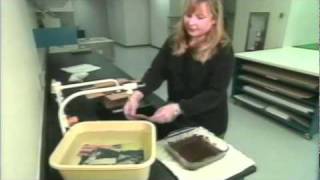 ▶Recovering photographs after a water emergency👀 Watch for: handling wet snapshots by the edgesOpens on YouTube in a new tab
 ▶Salvage of water-damaged photographs, step by step👀 Watch for: the whole sequenceOpens on YouTube in a new tab
 ▶How a photograph conservator works👀 Watch for: why some jobs go to a specialistOpens on YouTube in a new tab
 ▶Cleaning very moldy film👀 Watch for: cloth changesOpens on YouTube in a new tab
📝 Worksheet 18: Fire, smoke, water and mold: damaged media
Part A: Quick check
Click one answer. Green means correct. Red means try again. You can try as many times as you need.
1. How long before mold starts on wet photos and paper?
✅ That is why wet items are dried or frozen quickly.
2. Too many wet photos to dry in time. What can be done?
✅ Freezing stops mold and lets us thaw and dry a few at a time.
3. Which wet item must NOT be frozen?
✅ Freezing can damage the tape and its binder.
4. How is soot removed from an album cover?
✅ Rubbing or wetting drives oily soot into the surface.
5. A wet framed photo arrives. What is urgent?
✅ Once it dries against the glass, it bonds.
6. Mold on a photo is cleaned when it is:
✅ Damp mold smears into the surface. Dry mold brushes away.
7. Before any risky treatment on a damaged item, we always:
✅ The capture is insurance if the treatment fails.
Part B: Hands-on practice
Do each task with real equipment and practice media. Tick it when you have done it. Your trainer signs when they have watched you do it.
| I did it | Task | Trainer initials |
|---|---|---|
| Put on full PPE in the correct order and remove it without contaminating yourself. | ||
| Rinse and lay out wet practice prints for air drying. | ||
| Use a soot sponge correctly on a practice album cover. | ||
| Sort a mixed "flood" practice box into: dry now, freeze, keep wet, specialist. | ||
| Brush dormant mold from a practice print under extraction. | ||
| Write condition notes with photos for a damaged practice item. |
Part C: Write or draw your answer
1. Explain why freezing helps wet photos but harms tape.
2. A client asks "can you save it?" about a melted cassette. What do you say?