Handling, intake and safety
How to receive a job, track every item, set up a safe table, and spot the hazards that mean STOP.
🧰 What you'll need
Every tool and supply named in this unit. Dotted-underlined words in the text jump back here. Buttons open that store's search for the exact product. Prices are rough ranges in Canadian dollars.
Nitrile gloves, powder-free under $25
What it is: Thin disposable rubber-like gloves. They keep skin oil off film and glossy photos and still let you grip.
Our pick: Any powder-free nitrile exam gloves, in your size (S, M, L). Not latex, not vinyl.
In a store: Pharmacy, Costco, hardware store
Rocket blower under $25
What it is: A rubber bulb you squeeze. It puffs clean dry air to push dust off without touching.
Our pick: Giottos Rocket Air Blaster, large
In a store: Camera store
Anti-static brush $25 to $100
What it is: A very soft brush whose fibres remove static, so dust lets go of film and prints.
Our pick: Kinetronics StaticWisk, 2 inch or 4 inch
In a store: Camera store
Microfiber cloths under $25
What it is: Soft woven cloths that lift dust and smears without scratching glass.
Our pick: MagicFiber microfiber cleaning cloths, pack of 6 or more. Wash with no fabric softener.
In a store: Dollar store, optical shop, hardware store
Soft pencil (2B) under $25
What it is: A soft graphite pencil. It is the only thing we ever write with near originals, because it does not bleed and can be removed.
Our pick: Staedtler Mars Lumograph 2B
In a store: Staples, Michaels, dollar store
Painter's tape under $25
What it is: Low-tack paper tape that peels off cleanly. For labelling containers and holding cracked glass together. Never on a photo, film or tape surface.
Our pick: ScotchBlue Original painter's tape, 24 mm
In a store: Hardware store
Removable labels under $25
What it is: Paper labels that peel off without residue. For cases, boxes, reels and trays.
Our pick: Avery removable multi-use labels
In a store: Staples
Job trays under $25
What it is: A shallow tray or bin that holds one client's job and travels with it through every stage.
Our pick: Cafeteria-style trays or stackable letter trays, one per active job
In a store: Staples, dollar store, restaurant supply
N95 mask under $25
What it is: A fitted filter mask that stops mold spores and soot. A cloth or surgical mask does not.
Our pick: 3M 8210 N95 respirator
In a store: Hardware store, safety supply
Client and job drives $100 to $500
What it is: External drives. The job drive holds work in progress. The client drive is what we hand over, formatted exFAT.
Our pick: Samsung T7 portable SSD or WD Elements portable drive
In a store: Staples, Costco
Your work table
✔ Do
- Wash and dry hands at the start, after breaks, and after touching your face or phone
- Hold prints and film by the edges
- Support large or fragile items with two hands, or carry them on a board
- Keep a clear space on the table for the item you are working on
✘ Do not
- Wear hand cream, sanitizer residue or wet hands near originals
- Use cotton gloves on slippery or brittle items. They snag and you lose grip
- Stack photos face to face
- Use rubber bands, paper clips, staples, tape or sticky notes on originals
Intake: receiving a job
- 1Clear the table
Only this client's items.
- 2Count with the client or supervisor
Count each media type separately. Write the numbers on the job sheet.
- 3Photograph everything
The whole pile, then each container, then any existing damage, close up.
- 4Assign the job number
Put it on the tray and on every container.
- 5Label each item
Tapes and reels: label on the case and a small label on the shell edge. Loose photos: an envelope with the number, never a label on the photo.
- 6Record the original order
Photograph album pages and slide trays so the order can be rebuilt.
- 7Write down what the client said
Dates, names, "this one is the wedding", "skip the blurry ones". These become file names later.
- 8Note every bit of damage
Cracked shell, mold, tears, stuck photos, a smell of vinegar. The client signs or is told before work starts.
- 9Put the tray in its shelf spot
One spot per job.
Item numbering
- Pattern
- JOB-TYPE-NUMBER
- Example tape
- 2611-VHS-03
- Example reel
- 2611-F8-01
- Example photo batch
- 2611-PH-B02
- Rule
- Numbers never change after intake
🏷️ Porthos station card fill in once, it saves on this computer
Hazards: when to stop
| Hazard | How to recognise it | Why it matters |
|---|---|---|
| Mold | White, grey or green fuzz or spots on tape edges, film, slides or album pages. Musty smell. | Bad for lungs. Spreads to our machines and to other clients' media. |
| Vinegar syndrome | Film or negatives that smell like vinegar. Film may be wavy, shrunken or brittle. | The film base is breaking down. It is contagious to other film stored nearby. Needs priority handling. |
| Nitrate film | 35 mm movie film or old sheet negatives with the word NITRATE on the edge, usually before 1951. | Burns very fast and can catch fire from heat. Home 8 mm and 16 mm film is safety film and is not nitrate. |
| Broken glass | Cracked frame glass, broken glass slides, glass plate negatives | Cuts. Glass shards scratch photos. |
| Sticky or shedding tape | Tape that squeals, leaves brown or black powder, or sticks to itself | Clogs heads in seconds and tears the tape. |
| Water, soot or pest damage | Wet or warped items, black soot, droppings, insects | Health risk and special handling. See Unit 18. |
Smells are information
- Vinegar = acetate film or acetate audio tape breaking down.
- Musty, basement = mold is or was present. Look closely with a light.
- Smoke = soot is on the surface. Soot is abrasive. Do not wipe it dry with a cloth.
- Crayon or waxy smell on reel tape = some old tape binders. Tell a supervisor before playing.
Moving through the workflow
| Stage | You must have this before moving on |
|---|---|
| Intake | Job number on everything. Counts. Photos. |
| Inspect | Media type identified. Damage noted. Hazards cleared by a supervisor. |
| Prepare | Item is clean enough and stable enough to capture safely. |
| Capture | Master file saved in the job folder with the correct name. |
| Check | File opened and checked at start, middle and end. |
| Finish | Access copies made. Names match the job sheet. |
| Deliver | Files on the client's drive or link, plus our 2 backups. |
| Return | Every original counted back into its container, in original order. |
 ▶Safe handling of library and archival materials👀 Watch for: how items are supported with two hands and carried flatOpens on YouTube in a new tab
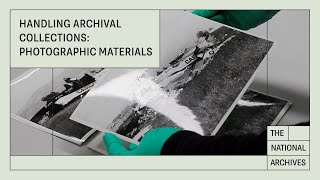 ▶Handling photographic material👀 Watch for: holding by the edges, and what gloves are used forOpens on YouTube in a new tab
 ▶Gloves or no gloves?👀 Watch for: how the decision is made for each kind of objectOpens on YouTube in a new tab
📝 Worksheet 2: Handling, intake and safety
Part A: Quick check
Click one answer. Green means correct. Red means try again. You can try as many times as you need.
1. You open a box of film reels and smell vinegar. What do you do first?
✅ Vinegar smell means the film base is breaking down. A supervisor decides the handling.
2. Which glove type do we use for negatives and slides?
✅ Nitrile keeps skin oil off the film and still lets you grip.
3. Where does the job label go for a loose photo?
✅ Labels and adhesives never go on an original photo.
4. Why do we photograph everything at intake?
✅ Intake photos protect the client and us, and let us rebuild the original order.
5. White fuzzy spots are on the edge of the tape inside a VHS cassette. Which machine does it go in?
✅ Mold spreads to the machine and then to every tape played after it.
6. What do you use to blow dust off a negative?
✅ Breath contains moisture droplets. Heat warps film.
Part B: Hands-on practice
Do each task with real equipment and practice media. Tick it when you have done it. Your trainer signs when they have watched you do it.
| I did it | Task | Trainer initials |
|---|---|---|
| Set up a work table correctly from an empty table. | ||
| Do a full intake on a practice job of at least 3 media types, including photos, counts and labels. | ||
| Put on and take off nitrile gloves without touching the outside of the glove with bare skin. | ||
| Pick up, carry and put down a large print using a support board. | ||
| Point to the 6 hazards on the hazard practice cards and say what you would do for each. |
Part C: Write or draw your answer
1. List the 6 hazards that mean STOP.
2. A client says "the red album is the most important one". Where do you record that, and why does it matter later?